My hero! He's returned!
I love Oliphant. Can't help it. Won't bother apologizing. From his first speaking appearance when interviewing Mallory, when he gazes off into the distance and ruminates on some mystic vision, he makes gallant Neddie look positively one-dimensional. Oliphant seems just as schizophrenic as Ada, then swings back with some admirably self-assured promises of mystery and intrigue. My kind of man.
Reading this iteration brought me to the conclusion that the story in the middle three iterations is entirely crap, and could be mostly removed. Oliphant is our hero and Sybil, via likeable Mick, his catalyst. The stories in the first and fifth, wrapped up cleverly in the Modus, are the true grit of the story. I think what most readers complain of is falling too into the pulpy Mallory bits and ignoring the political affairs entirely.
What's most interesting about said political affairs is that they're comprised mainly of North American troubles, albeit affected by our characters in London and Paris. Europe is nothing more than a pretty tinted filter for those intricate plot developments: Britain's petty uprising during the Stink came to nothing, while the movements of American Marxists and sub-factions thereof are going to have far more interesting repercussions. The depiction of Marxism in the book is going to be worth of its own post soon, I'm afraid, so I'll leave this train of thought here.
I found all sorts of things in this chapter endearing. I loved the sneaky bits with Wakefield and his assorted spies and messengers; I loved Mister Hermann Kriege and the idea of Oliphant as an 'Uncle Larry.' I like the idea of "factions within the Party... Anarchists disguising themselves as communists... covert cells not under Manhattan's control...." I'm baffled by the pantomime, alarmed by the rubber bathtub, and rather despondent about the whereabouts of Betteredge. All in all, an excellent time was had.
(Oh yeah, and there was that evil-men-apprehended-world-turned-to-rights-everybody-rejoice stuff too. That was good, too.)
Iteration the Fifth.
Dramatis Personae: Lord and Lady Byron.

With thanks again to Bartlett's Familiar Quotations, I managed to snag a few Byron quotes from some of his major works. While I'd by no means say Byron was a political poet, it's about as possible as it is with any prose-writer that his words could be taken as incendiary mottos. From Childe Harold's Pilgrimage:
"Who would be free themselves must strike the first blow."
"He who ascends to mountaintops shall find
The loftiest peaks most wrapt in clouds and snow;
He who surpasses or subdues mankind
Must look down on the hate of those below."
"Yet, Freedom! yet thy banner, torn, but flying,
Streams like the thunderstorm against the wind."
And from The Corsair:
"Such hath it been - shall be - beneath the sun
The many still must labour for the one."
(Plus, he wrote a poem about Keats after his death! As did Shelley!)
The issue created in the Modus is of Anne Milbanke, the Iron Lady, not only staying with him after Ada's birth in '16 but actively encouraging him -- then using his power for her own ends. This strategy on the part of the authors was advisable, as not much in the way of historical biography exists to refute the possibility. This insinuation of the Iron Lady as the catalyst for Ada's and Babbage's passions, as as driving force bigger than characters like Byron, Wellington, Shelley, and Disraeli -- well, it's a powerful one for me.
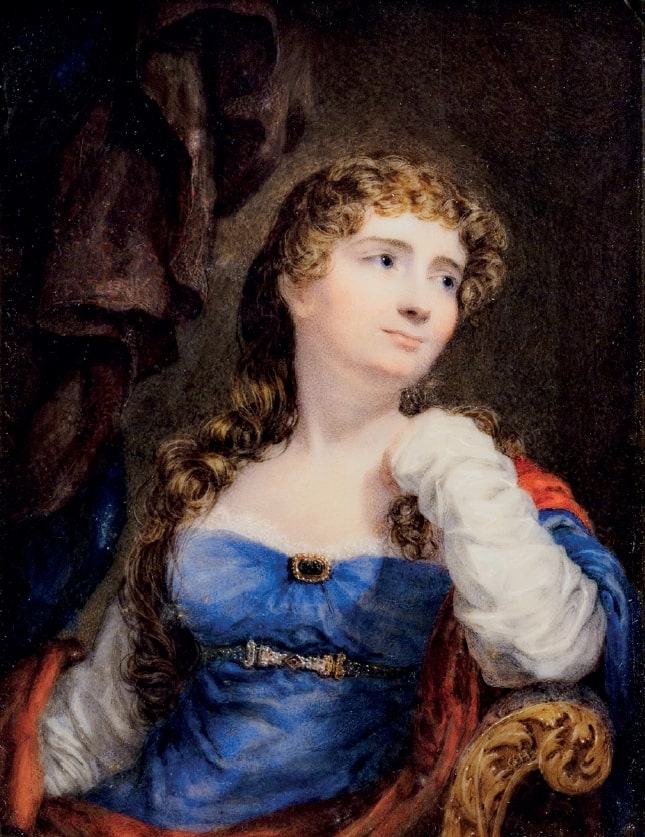
What we do know about Lady Byron is that she held her own political views, including abolishing slavery, and was quite outspoken about them. She was also an excellent student, especially in mathematics. I don't want to run too far into Ada territory on this one, so suffice it to say I'm a huge fan of the Iron Lady coup in the Modus. It's the sort of clever spin you wish hadn't come so goshdarn late in the storyline.
Iteration the Fourth, Redux.
For the purposes of getting myself up to speed, I started back mid-fourth, just after the sex scene: Mallory walks a deserted, apocalyptic Whitechapel at dawn. While I'm a big fan of anarchic scenes in fictional texts (Mad Max, anyone?), this imagining really wasn't so imaginative.
Okay, the descriptions of a madman's propaganda were cool, what with seven-cursed whores and pounds of flesh and etc. But, apart from irksome dialogue and some entertaining diversory references ("... Wait, did that just say 'Reverend' Wordsworth?!"), the rest of the iteration is pretty pulpy, full of sound and fury. The ending contains a passage I can't let go, no matter how I wish I could: "A section of roofing collapsed, quite slowly, like the wing of a dying swan."
The image following, of Mallory strolling jauntily through burning wreckage, broken-shoed and blurry-eyed, grinning dreamily, to emerge into a London rain -- that's a relief, a classic Bond-style ending, something canonical with which to end all the campy farce. The iteration gave a lot more, reference-wise, on second reading, but my opinion stays the same: Dreck. Utter.
Mad Max: We don't need no stinkin' moral high-ground.
The way the authors open and close their iterations is worth a moment: I wouldn't identify the choice as stylistically sound. The abstracted, personality-less descriptions of tableaux do nothing to class up the pulpy mid-sections, nor does the rollicking high-energy storyline lend an elegant contrast to the bookends.
While I wouldn't exactly call the presentation "disruptive," this is only by virtue of the whole experience lacking in any immersive qualities. It simply doesn't work for me, and I don't know why the authors chose it.
I see Gibson's cyberpunk style perverted in two directions: I miss the cool, sterile voice of Virtual Light and Neuromancer observing uncomplicated characters moving fluidly between scenes of violence, tension, sex, and awe. Here it's split in two directions: cheesy, faux-clinical analysis marred with single-line paragraphs, and flat, uninviting protagonists inexplicably endowed with moments of inspired action.
Maybe I'm imposing expectations based purely on the relative contexts: people from the past are automatically naive and simple, while people from the future are impossibly complex and subtle. It could just be a reflexive dislike from the overuse of exclamation marks. Too many "cried," too many "Dammes."
Guns of the Rad Lords' Era: Part One - The Pepperbox
In her last post Allana mentioned looking up the Ballester-Molina handgun, which led me back to the book looking for a reference to it. The Ballester-Molina was an Argentine handgun first produced in 1938, making it an odd anachronism for this book. (Unlike Allana, I am still wired, and am weakly dependent on Wikipedia and flagrant unsubstantiated rumor.)
Maybe it's odd to nitpick anachronisms in a book the very premise of which is the effects mechanical computing would have had on the Victorian Era had it been as widely adopted as electronic computing was in the 1990s. But in every other respect this book has been so meticulously researched that it would really bother me if this handgun, decades out of place, somehow worked it's way in.
A quick thumb through of the novel again tonight did not turn up a reference to this gun. Allana, did you find a mention of it in there? I see it is in the Difference Dictionary, so it must be in there somewhere.
At any rate, the thumb through led me to this post, which, although it first must contain an apology for being so long in coming, also contains a the first of a list of guns used by people in the novel, which will make everything better, as guns notoriously do.
Pepperbox - Mick Radley's little pocket gun, looted from his corpse by the mysterious Ranger who then used it to shoot Sam Houston in the early pages of the book:
This image of a 1837 pepperbox revolver comes from Jimmy Smith's photostream.
The pepperbox was widely available in Victorian England and commonly used for self defense. It was cheap to make, much less complex than a single barreled revolver. Mick's was delicately made enough that the Ranger breaks the trigger accidentally after three shots. It is first described when Sybil mistakenly pulls it our of Mick's coat pocket:

Her left hand gripped a lump of hard, cold metal. She drew out a nasty little pepperbox derringer. Ivory handle, intricate gleam of steel hammers and brass cartridges, small as her hand but heavy.
(The Difference Engine, Page 7)
Given that description, it probably looked something like this:

Instead of the wooden handle, imagine ivory, and imagine the rotating barrels to be brass, and you'll basically have it.
Howerver, given that Mick is a self conscious Dandy and a bit of a Victorian Gadget Geek, I like to imagine he carried this version instead:

Even in its less ridiculous straightforward model, it was not easy to aim, the hammer often obscuring a good sight down the barrel, and so was usually shot unaimed at close range. Although this gun existed in some form as far back as the 1400s, the version of it that Mick would have owned was designed in the 1830s and had a long, respectable life. In addition to being cheap, it was also a little safer than a single barreled revolver, in that should a discharge accidentally light the powder charges in the other barrels, all the slugs had their own barrels to exit from. In a single barreled revolver, the there could be an injurious backfire. In the pepperbox, you'd just end up blasting your target with all barrels at once.
The Ranger gets off three shots with Mick's pepperbox before breaking the delicate trigger in his beefy Texian hands. The first one is aimed, the book tells us, but at very close range as Houston is standing right in front of him. Houston doesn't try to dodge, but challenges the Ranger to shoot him directly in the chest, which he does. But what happens next is telling. The Ranger leaps on Houston and presses the rotating barrel directly against Houston's body, firing two more times with the gun actually pushed physically into Houston's chest. This would be the surest way of insuring that you hit your target with such an iffy gun.
I really appreciate it when writers research details like this well enough to describe their characters using period items in likely ways.
There are several more guns in the book, and now I'm interested to find out if they are all treated as faithfully!
Terminology Rock, or, A concise apology to the Internet.
A rare archival photo of Allana at her summer job?
I spend my summers doing manual labour, living in a tent. It's not glamorous, but it is good for the skin. (Until I get cancer.) Since I've been back, I've lived in a house on a dirt road, kilometres from the nearest convenience store. I don't have internet access at home. Thus, a six-month delay in both finishing book and blog and removing the word "failure" from my self-description.
I will, however, let you in on a choice upside to my current hermitage in the wilderness: my house contains a respectable library to which I have unfettered access. (I fancy myself a bit of a caretaker, actually.) What this means for you, dear reader, is that whenever I look something up in the Oxford Universal, the Chambers Biographical, or Bartlett's Familiar Quotations (so good), you now have the assurance that I haven't just copy-pasted some quasi-reliable Wiki, or even done a lackadaisical search on the Difference Dictionary. I'm doing it the old-fashioned way for the first time in my short, technology-addled life. And it's embarrassing to note how weak my short-term memory can be, and how desperately I wish these books were illustrated.
For example, the Leyden-jar mentioned on page 245, according to the OUD, is an electrical apparatus conducting charge from a tinfoil-coated glass bulb via a brass rod running through its corked lid. It uses the phrase "communicating with the internal armature." Now you know. (Sort of.)
Then I asked the CBD about a "Ballester-Molina" handgun, only to find a golfer and a Jesuit, which, though unhelpful, led me on a fascinating referential journey on the concept of original sin. (From 1449: "The sect of Pelagianys, which helden that a man bi his fre wil mai deserue heuen withoute grace.")
A phalanstery, circa 1850, refers to the Rousseauian and Fourierist (that's Charles, the social theorist, not Jean Baptiste, the mathematician that hung out with Napoleon) conception of small, socially integrated communities, self-sustaining and familiar. Rooted from "phalanx." Related to Panty-suckers. Err, Pantisocrats, who simply think all men are equal.
(And did you know that there is a Samuel Coleridge-Taylor, not just a Samuel Taylor Coleridge? The former being the composer of Hiawatha, I feel it would be especially unfortunate to confuse the two.)


Disaster! - Iterations Third and Fourth.
What I got out of these sections were a few ice floes of clever awash in an Arctic Ocean of dumb.
The passage about the windup girl seems the most gratuitous, though I said that about Rudwick, and Keats, both of whom have resurfaced multiple times since, if only in passing mention. But I'd hate to come up with some sort of exciting twist involving a Japanese drink-pouring automaton, so I'll keep my fingers crossed that it was just a pointless aside. I'm actually hoping for some of these plotlines to go unfinished, else it's going to be a slugger of an ending.
The extended sex scene in Sybil Jones's old room comes in a close second. No revelations there, unless you consider filthy gossip about the royal family useful. Maybe the authors felt the passage was needed to paint Mallory in a human light -- troubled, lonely. Mostly it just reminded me how easy it is to make sex lurid and decadent, even in print.
I will tell you what I loved about these two iterations: J. J. Tobias, Esq. What a satisfying little character he was -- everything from the great haircut to the cunning quip about everything taking twice as long as you think. (I really thought there was a natural law about this, but the name eludes me.) He had just the right touches of bashfulness and pride, eagerness to please and anxiety about breaking the law. And I could hear his cockney accent pouring through -- somehow they nailed his dialogue.
Basically I think these two iterations were a mess -- a lot of flashy plot movement all to say "Hey, Mallory's in trouble." I've gathered from reading other reviews that this was the main plot section, that the bulk of the sociopolitical hypothesizing was here -- part of me is disappointed, thinking that everything else will just be cleaning up the plotlines we've left open, but I'm partially relieved for the same reason. Maybe without that big save-the-world relevance they felt their book needed to contain, they can let loose with a bit more humour and ... well ... I'm not really sure what I'd want them to do. Surprise me, I guess.

 Posts
Posts

